How an inaccurate label became synonymous with danger, the history of the “nanny dog”, and what actual science says about canine behavior.

Few dogs have been judged as intensely by their appearance as pitbulls. The most common mental associations are aggression, fighting rings, and danger. To those who actually know about the breed (which it actually isn’t one), they are simply loyal family companions who have been unfairly stereotyped.
The history of the “pitbull” includes working-class companionship, blood sports, selective breeding, irresponsible ownership, sensational news coverage, and neverending debate over alleged public safety concerns, which is usually nothing more than racist-like mentality in dog format. History requires verifying and separating what is simply documented from what actually occurs in reality. Unfortunately, the writers of history rarely depend on accuracy. Sorry if this comes as a shock to you.
The central issue is not whether pitbulls are dangerous. Any dog can bite. Chihuahuas, one of the smallest breeds, have the most notorious bite track record. And yes, a larger, more powerful dog can cause devastating injuries. But the more useful question is whether the term pitbull tells us enough about a particular dog’s ancestry, temperament, or likelihood of attacking someone to justify the assumptions people often make. Evidence suggest that it does not.
Where did the term “pitbull” come from?
The name “pitbull” has historical roots in the use of dogs for pit fighting, but it is not the name of one universally recognized breed.
In Britain, bulldog-type dogs were historically used in bull-baiting, a blood sport in which dogs were set against tethered bulls. After bull-baiting and other animal-baiting sports were prohibited in Britain in 1835, some enthusiasts continued breeding and using dogs for underground dog-fighting. Terriers were intentionally bred with bulldogs to produce animals valued for a combination of athleticism, tenacity, and other working traits.
The word “pit” refers to the fighting pit, while “bull” reflects the bulldog ancestry and historical association with bull-baiting. The expression became associated with dogs used in fighting and, eventually, with a broader family of dogs sharing certain physical characteristics and ancestry. The label does not necessarily identify one specific genetic lineage.
Immigrants brought some of these dogs to the United States, where they took on various roles, including farm work, hunting, vermin control, guarding, and companionship. Different breeding populations developed over time. These days, most “pitbulls” you will find are actually mixed or outright mutts. As are most dogs you’ll come across – no matter what your “ethical breeder” told you.
So is “pitbull” actually a breed?
Generally, no. It is an umbrella term rather than one official single breed recognized by any major legitimate animal organization. Depending on the organization, jurisdiction, shelter, or individual using the term, it may refer to:
- The American Pit Bull Terrier.
- The American Staffordshire Terrier.
- The Staffordshire Bull Terrier.
- The American Bully.
- Mixed-breed dogs that resemble one or more of these dogs.
Basically, it is literally anyone’s guess. None of these are interchangeable names. They refer to distinct breeds or, in the case of “pitbulls,” simply a descriptive category – one that has no real parameters outside of the court of public opinion. Most notably, the first category alone has no specifically-defined limits. A more accurate statement is that “pitbull” is not a single, consistently defined breed designation. The closest you will come is specific pitbull-type breeds (a.k.a. “bully” breeds) are formally recognized.
This distinction is important whenever people cite statistics about pitbulls, as they are inaccurately defining the premise of whatever it is they may be referring to. Any dog included in “pitbull” statistics represents any number of breed, ancestry, or behavioral profiles.
Were pitbulls really “nanny dogs”?
One of the most rehearsed arguments made in defense of pitbulls is that they were once known as nanny dogs: trusted family dogs whose job was to watch over babies and protect children while their parents were away. This is an appealing story, but it does lack an important qualification: reliable historical evidence that pit bull-type dogs were widely or formally used as nanny dogs. But from what we know about history, it very well simply could have never been recorded in writing, rather passed down through generations as history often is.
The lore goes that pitbull-type dogs were kept as companions. They undoubtedly lived peacefully with children. Many historical photographs show bulldog-type dogs posed alongside families with children, where they sit in the frame as simply another family dog.
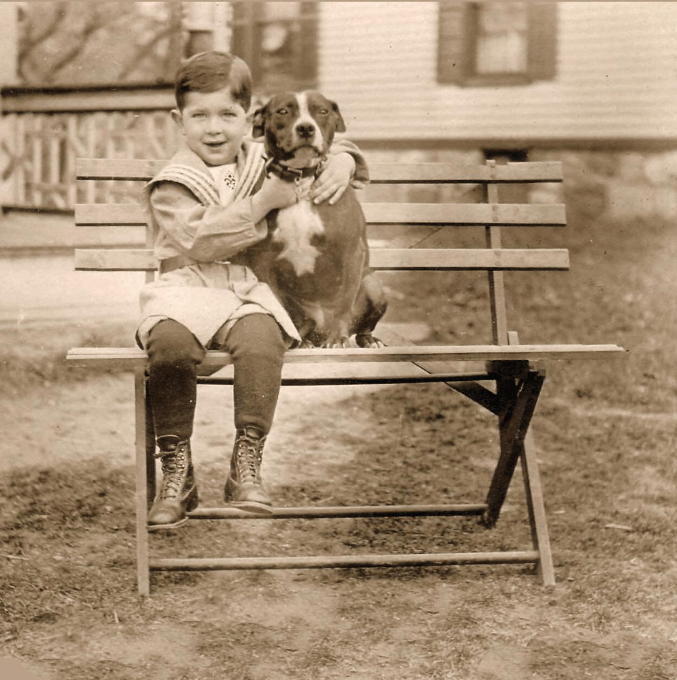
The claim that they were specifically bred or widely employed to supervise children, however, goes beyond what historical record could provably establish. The difference is simply between saying that pitbull-type dogs can be loving family pets, versus claiming that they were historically relied upon to babysit children. The second is unprovable, and not really a necessary claim to be made for the purposes of this article.
It is not really worth stating the obvious that no dog, regardless of breed or reputation, should be treated as a substitute for adult supervision around a child. Any dog or breed can be gentle for years and still react unpredictably to pain, fear, startling contact, or a stressful situation. The strongest defense of these dogs does not require a nanny-dog story. It rests on a more defensible principle: individual dogs should be assessed by their actual behavior and circumstances rather than by an embellished story about their past, be it overly positive or unnecessarily negative.
How dogfighting ruined everything
The history of dogfighting is real, and it still exists today. Ignoring it would weaken any serious discussion of pitbull-type dogs.

Some bull-terrier descendants were deliberately selected for participation in fighting. Breeders favored traits like tenacity, athleticism, strength, and persistence during conflict with other dogs. Selective breeding could also produce dogs with a heightened tendency toward dog-directed aggression, especially depending on the environment in which they were raised.
However, genetic history is not scientifically predeterminate of behavior. Some pitbull-type dogs may present particular management challenges around other animals, but epigenetic studies have proven across species that genetics can easily be overridden.
On a separate but related note: aggression toward other dogs is not the same as aggression toward humans. Behavioral tendencies are not interchangeable. A dog’s response to another dog cannot automatically be translated into a prediction about its behavior toward a person, or even a different dog.
From working dogs to icons of danger
The public image of pit bulls changed considerably during the late twentieth century, especially during the 1980s and 1990s.
High-profile attacks and stories about illegal dogfighting attracted public attention, in the same way negativity rises to the top of your social media algorithm. Media portrayals increasingly associated pitbull-type dogs with violence, criminality, and irresponsible ownership. Many owners deliberately cultivated intimidating images of these dogs, going so far as to medically damage them with ear-cropping (a completely unnecessary procedure outside cosmetic reasons – never trust any vet who does this in their practice).

A 2025 scholarly analysis by Michael Tesler and Mary McThomas, published in Animals, examines how negative media portrayals contributed to public fear and the consequential (misinformed) spread of breed-specific legislation. The researchers describe how highly publicized incidents helped turn a broad category of dogs into a symbol of a much wider perceived public-safety threat.
This created a feedback loop:
- Dogs involved in particularly severe attacks received extensive news coverage.
- The label “pitbull” became public shorthand for “danger.”
- Public fear encouraged calls for restrictions and bans.
- The resulting political debate further reinforced the association between pitbull-looking dogs and aggression.
Not surprisingly, a lot of legislation is passed through news and fear. That is an entirely separate topic that cannot be covered in one article. The problem is not that reporting on serious events is inherently wrong. The problem arises when coverage of individual events becomes a generalized conclusion about everything that resembles the subject involved. This concept naturally extends to humans and stereotypes as well.
Dogfighting contributed to the stigma simply due to “guilt by association.” The dogs, rather than their owners, became associated with the criminal activities of said owners. That association obscures an important distinction: the existence of abusive breeding and fighting operations bypassing scrutiny and placing blame on the victims, namely the dogs bred within these operations. Dogfighting does not establish the behavior of every dog placed under the same broad label, or any of them for that matter.
In other words, the history of dogfighting is only an explanation for the pitbull’s reputation. It is nowhere near sufficient evidence that every pitbull-type dog is inherently dangerous.
The problem with identifying a “pitbull” by sight
One of the most significant problems with pitbull statistics begins before anyone even counts a bite: how exactly did you identify this dog as being a pitbull?
In everyday use, people often label a dog a pitbull because it has a broad head, a muscular body, a short coat, a stocky build, or a particular facial shape. Not only are these features not exclusive to any particular breed, but dogs with similar appearances may in fact have very different ancestry. Conversely, dogs with pitbull-type ancestry may not look like what a person expects a pitbull to look like. A mixed-breed dog may inherit a broad head and muscular body from one part of its ancestry while inheriting other physical characteristics from entirely different breeds. Visual identification is therefore simply a guess, not a genetic test.
What does the research say?
A 2015 study published in The Veterinary Journal, titled “Inconsistent identification of pit bull-type dogs by shelter staff,” examined breed identification in animal shelters. Researchers compared staff assessments of 120 dogs with DNA-based breed identification.
The findings said enough:
- Shelter staff collectively identified 62 dogs, or 52%, as pitbulls.
- DNA testing identified 25 dogs, or 21%, as having the study’s defined pitbull breed signatures.
- Agreement between visual identification and DNA results varied considerably between observers.
The study concluded that visual identification of pitbull-type dogs was unreliable.
Even DNA testing does not provide a perfect account of every dog’s ancestry. Results depend on the reference breeds and methods used by the testing company. This study demonstrates why an observer’s impression should not automatically be treated as a verified breed classification.
The implications extend well beyond animal shelters or veterinary hospitals.
If a witness, journalist, police officer, or medical record describes a dog as a pitbull based primarily on its appearance, that label enters a report or database with zero genetic confirmation. Later reports that repeat the description ultimately create an appearance of certainty that the original identification did not warrant. A dog can become a pitbull “statistic” simply because somebody thought it looked like one. And the principle stands: history is up to whomever documents it.
Of course, this does not establish that every reported pitbull attack involves a misidentified dog. Some dogs are correctly identified, and some are not. The point is that visual identification introduces uncertainty that must be acknowledged when examining statistics. Statistics, after all, must be analyzed and not simply regurgitated.
So what are stereotypes actually based on?
Much of the public opinion of a pitbull is based on a combination of:
- Physical appearance: Muscularity, broad heads, and strong jaws are interpreted as evidence of an aggressive temperament.
- Historical associations: Dogfighting is treated as representative of every dog within the category.
- Media exposure: Memorable attacks receive more attention than uneventful everyday interactions.
- Labels assigned by observers: Dogs that look intimidating are more likely to be placed in the category that people already fear.
- Assumptions about ownership: The stereotype of the irresponsible or aggressive owner becomes attached to the dog itself.
These factors reinforce one another. A muscular mixed-breed dog may be labeled a pitbull because of its appearance, and an incident involving that dog may then be presented as further evidence that pit bulls are dangerous. The label thus influences the interpretation of the event, and the event reinforces the label. This is not in any way a scientific method of forming a conclusion, or a way to predict dangerous behavior.
Why dog bite statistics are more complicated than headlines suggest
Statistics about dog attacks are frequently used to argue that pitbulls are either uniquely dangerous or unfairly blamed. Neither conclusion should be accepted without examining what the data actually measure.
A dog-bite database might record the breed reported by a victim, a witness, a police officer, or a medical professional. Another might include only hospital-treated injuries, severe attacks, or fatalities. And another database might include any reported bites, including relatively minor incidents or ones that were in fact the fault of the person making the report.
Limitations of breed-specific fatality data include inaccurate breed identification and the difficulty of calculating reliable rates without knowing the size of a given breed’s population. Consider the difference between these two claims:
“A particular type of dog was involved in a large number of reported severe attacks.”
“An individual dog of that type is more likely to attack a person than an individual dog of another type.”
The first is a statement about the net number of recorded cases. The second is a subjective claim about risk with no regard to the size of the population it refers to, or proper identification.
To compare breed-specific risks properly, researchers need reliable counts of incidents, reliable identification of the dogs involved, and reasonable estimates of how many dogs of each breed or type are in the population being studied. Ideally, they would also account for factors such as age, sex, management, exposure to people, and the circumstances of each incident. None of these data points are widely available because they are inaccurate to begin with, again being mostly based in public opinion. Without these common denominators, a count of reported incidents cannot establish the probability that any individual dog will bite.
Does that mean pitbull-type dogs are never overrepresented in serious attacks?
That would be a misleading conclusion based off publicly accessible data, if that is indeed all we have to refer to.
A 2021 systematic review of research published between 1971 and 2018 found that pitbull-type dogs and German Shepherds were consistently implicated in a substantial share of the most serious dog-bite injuries reported in the medical literature. Again, we can only refer to what has actually been reported and documented, along with any corresponding limitations of that data.
That said, this study reviewed heterogeneous research populations and medical literature, not a perfectly-weighted census of all dogs and all bites. It does not, by itself, tell the absolute risk posed by every individual dog in a particular category.
Further, there must be a distinction between bite frequency and severity of injuries. A larger, stronger dog may be capable of causing more severe damage than a smaller dog, even if both are responding to similar circumstances. A comparison based on hospitalizations or fatalities is therefore not equivalent to a comparison based on the likelihood of any bite occurring.
The most scientifically reasonable position is to take severe attacks seriously while being precise about what the available data can and cannot establish.
The Hollywood effect: why the most frightening incidents shape public opinion
Media coverage is not a random sample of everyday dog behavior. It is inherently a distorted take on reality, one with a financial incentive of chronic viewership behind it.
A dog that lives peacefully with a family for years is unlikely to generate a national headline. A fatal attack, a dramatic rescue, or a dogfighting investigation is much more likely to attract widespread attention. This is a basic feature of “newsworthiness”. It is not necessarily evidence of a coordinated effort to mislead the public, but it does distort their perceptions of how common an event is in reality.
The psychological term for this phenomenon is the “availability heuristic”: people tend to judge how likely something is partly by how easily examples come to mind. So if someone repeatedly sees dramatic stories about pitbulls, those incidents become encoded in their memory. The person may then perceive the category as unusually dangerous with no reliable information about the number of dogs involved, the number of bites, or the circumstances of any case that comes to mind. Only that it comes to mind.
The problem of selective coverage
Research on pitbull media portrayals documents how high-profile attacks and negative characterizations contributed to public fear, particularly during the late twentieth century. The 2025 Tesler and McThomas analysis also notes that unfavorable portrayals persisted in news media even as more positive accounts of these dogs appeared in popular culture, banking on a culture of negativity.
The important distinction here: the fact that attacks are newsworthy does not make the attacks imaginary, but it does mean the number of frightening headlines is not a reliable indicator of risk.
A headline might emphasize a dog’s alleged breed, its physical appearance, or the severity of the injuries. It may devote less attention to details such as whether the dog had a history of aggression, whether it was roaming loose, whether several dogs were involved, or any other number of factors involved. Sometimes those details are unavailable. Sometimes they are investigated later. Sometimes early breed descriptions are repeated without correction. And sometimes – most of the time – it simply wouldn’t make for as enticing of a headline news story. A reader who encounters only the initial headline may form a conclusion before the facts are established, which is in fact the unstated goal of headline writing. Details are unnecessary so long as they do not support the headline.
This same issue applies to other breeds, of course. A serious attack by a German Shepherd, Rottweiler, Husky, or another large dog can also be framed as evidence about an entire category. But once a breed has acquired a powerful cultural association with danger, similar events may be interpreted differently depending on which label appears in the headline.
Is the media deliberately trying to incite fear?
Is water wet? Hopefully you can decide for yourself after reading this far. The media, by nature, must have a deliberate goal of getting repeat non-paying customers with a constant “free” output of “information.” I will leave that idea to you to unpack.
It may be difficult to prove journalists as individuals are intentionally trying to frighten the public. However, sensational framing can result from competition for attention, assumptions about what readers find compelling, established stereotypes, or the simple preference for dramatic events over ordinary ones. Again, the news is free, yet its creation and curation is definitely not. Gathering and analyzing information does require time and labor after all, and there is no incentive for anyone to do it on a consistent basis without some kind of return on investment.
A simple evidence-based statement is that selective and sensational coverage can amplify fear even without a deliberate campaign to create it, simply due to the nature of news and media themselves. It does not require assuming a conspiracy; it requires recognizing that a stream of exceptional incidents can shape perceptions in ways that do not reflect the full population of dogs or the full range of their behavior, especially when the general public isn’t necessarily interested in either of those things. News and media effectively both fall into the entertainment category, both consisting of people with the same job titles between the two.
So are pitbulls inherently more aggressive than other dogs?
The answer depends on what the term “aggression” means.

Aggression is not one single behavior. It can include fear-based defensive reactions, territorial behavior, resource guarding, aggression toward unfamiliar dogs, predatory behavior, and responses to pain or stress. A dog can display one of these behaviors without displaying all the others. That same dog can also not display that behavior in an entirely different setting. Aggression is a trait, not a circumstance.
This matters because historical selection of some pitbulls for fighting other dogs does not automatically establish that they are more likely to attack humans. Nor does a friendly temperament toward people guarantee that a dog will get along with every other animal, or human.
Another source is the American Veterinary Medical Association, which advises against predicting an individual dog’s propensity for aggression solely from its breed. Its dog-bite prevention guidance emphasizes the importance of individual history, behavior, circumstances, and responsible owner management.
What genetics can, and cannot, tell us
A major study published in Science in 2022, “Ancestry-inclusive dog genomics challenges popular breed stereotypes,” examined genetic ancestry and behavioral traits in thousands of dogs.
The researchers found that breed ancestry was a poor predictor of an individual dog’s behavioral traits. Some behavioral tendencies had a genetic component, but individual variation within breeds was substantial. Physical appearance and breed labels could not reliably tell researchers how a particular dog would behave.
This does not mean genetics are irrelevant. Selective breeding can influence tendencies, and a dog’s inherited characteristics may affect its behavior. What it means is that behavior is complex and cannot be reduced to a simple rule such as “this breed is aggressive.” A responsible assessment considers the whole animal, including:
Its previous behavior around people and other animals.
Its responses to fear, frustration, restraint, and unfamiliar situations.
Its early experiences and ongoing socialization.
Its training, physical health, and living environment.
The owner’s ability to manage the dog’s needs and recognize warning signs.
Breed is one piece of context, not a complete behavioral assessment.
What about bite force and physical strength?
Pitbull-type dogs are often described as having uniquely powerful “lock-jaws”, or some special ability to lock their jaws. Claims about a literal locking mechanism are not supported by any established canine anatomy whatsoever. Like other dogs, they use their teeth and jaw muscles to bite. Differences in size, anatomy, motivation, and circumstances can affect the damage an individual dog causes. But there is no special documented anatomical “lock-jaw” mechanism going on that’s exclusive to pitbull-type dogs, anywhere outside the rumor mill.
Physical strength does matter. A powerful dog that bites can cause serious injuries, and owners should take that possibility seriously. But the same practical principle applies to any dog: size and strength affect the potential consequences of a bite, but they do not independently establish an individual dog’s likelihood of biting. Capacity and probability are two separate things.
The predictability myth in purebreds
Another common argument in discussions about pitbulls is that a dog with mixed ancestry is somehow less predictable or more dangerous than a purebred dog.
That assumption is not scientifically justified, nor is the fact that your dog is, in fact, purebred. Again: no matter what your breeder told you.
Most pets do not have a fully documented, multigenerational pedigree. Most are mixed breeds. And most, despite being sold or adopted under a particular breed label, have unverifiable ancestry, as the AKC does not provide any type of verification service between breeders.
Purebred dogs may have more standardized “pedigrees” or more predictable physical characteristics. Some inherited behavioral tendencies may even be more common in particular populations. But purebred status is not a guarantee of stable temperament, sound health, or safe behavior. A purebred dog can very much be fearful, unsocialized, aggressive, difficult to manage, or prone to health problems. The reverse is also true: A mixed-breed dog can be calm, sociable, and well adjusted.
The 2022 Science study is again relevant because it challenges the assumption that a breed’s average characteristics necessarily describe every individual belonging to that breed.
Why mixed ancestry is a useless shortcut for judging danger
Suppose two dogs have similar appearances. One has documented ancestry from a recognized breed; the other has an unknown background. It would be unjust to conclude the first dog is safe and the second dangerous, or vice versa, on that information alone. Unknown ancestry introduces uncertainty about lineage. It does not inherently establish a behavior problem.
Likewise, identifying a dog as a pitbull mix does not reveal what proportion of its ancestry comes from any particular breed, which inherited traits it possesses, or how it will behave in a given situation. DNA tests can provide useful estimates, but they cannot certify a dog’s likelihood of biting nor accurately predict every aspect of its temperament. A dog’s observed behavior, history, health, and management remain important regardless of pedigree.
Why breed-specific bans are controversial
Breed-specific legislation, commonly abbreviated as BSL, restricts or prohibits the ownership of dogs identified as belonging to particular breeds or types. Such laws are often introduced following highly publicized attacks, with an alleged goal of preventing future injuries. Supporters argue that targeting dogs perceived as particularly dangerous can protect the public. Critics argue that these laws depend on unreliable breed identification and do not adequately address the circumstances that contribute to attacks.
Again, first and very simply, if a law relies on physical appearance to identify a dog’s breed, visually similar mixed-breed dogs may be included even when their ancestry is uncertain. Dogs with relevant ancestry may also be missed.
Second, a breed label does not establish whether a particular dog has previously bitten, behaves aggressively, is securely contained, or is well-managed by the owner responsible for it, who is ultimately liable in court.
Third, focusing exclusively on breed diverts attention from way more important measures that would directly address obvious risks, including preventing roaming, enforcing leash and containment laws, supervising children around dogs, and responding appropriately to documented dangerous behavior. Once again, the AVMA’s guidance emphasizes prevention and responsible management rather than predicting aggression from breed alone.
This does not mean that every breed-specific policy has identical effects or that every legal question has a simple answer. The effectiveness of a particular law depends on its design, enforcement, local circumstances, and the quality of the evidence supporting it. So a law based on a broad visual category faces an equally broad problem: it classifies dogs according to what they look like rather than what they have actually done or how they are likely to behave.
An evidence-based (scientific) approach to public safety evaluates individual behavior, takes serious incidents seriously, and establishes clear expectations for the owners of said dogs.
How can we fairly assess pitbulls, then?
A fair assessment begins by asking better questions.
It is possible to reject blanket stereotypes without pretending that every pitbull-type dog is harmless. Some dogs have behavioral problems. Some have been purposely bred or trained for fighting. Some have a history of serious aggression. Powerful dogs can cause catastrophic injuries, and responsible owners must acknowledge the risks associated with their individual animals.
But those facts do not justify treating every dog assigned “pitbull” as though it shares the same ancestry, temperament, history, or risk profile.
Instead of asking only what breed a dog resembles, ask what is known about its actual behavior. Instead of assuming a muscular body indicates aggression, look at how the dog responds to people, other animals, stress, and unfamiliar situations. Instead of relying on a frightening headline, look for the underlying report and any holes in reporting, the circumstances of the incident, and the quality of the breed identification.
A dog of any breed should not be assumed safe because it belongs to a supposedly friendly breed, has a reputation as a family pet, or appears affectionate in photographs. No dog should be left unsupervised with a young child, and owners should take warning signs seriously. People should both recognize and respond to dog body language. Prevention requires practical precautions, not confidence in any particular breed’s reputation. This goes for any dog.
Judge the dog, not the mythology
To wrap this all up:
The term “pitbull” is way more of a cultural phenomenon than an actual scientific definition. Its origins are connected to genuine histories of bull-baiting and dogfighting, yes, but its modern use encompasses multiple recognized breeds, mixed-breed dogs, and animals identified primarily by appearance.
The claim that pitbulls were historically designated “nanny dogs” may not be well-established. Their association with dogfighting, however, is real and helps explain why some lines were selectively bred for particular physical and behavioral traits. In any case, neither of these items tells us everything about any individual dog.
Research into breed identification clearly demonstrates that visual labels are unreliable. Studies of canine genetics show that breed ancestry alone is a limited predictor of individual behavior. Research on media portrayals helps explain how memorable attacks can shape public perceptions, while public-health research highlights the difficulties of drawing breed-specific conclusions from incomplete bite and fatality records.
None of this is to say that dog attacks should be minimized or that concerns about safety are illegitimate. Victims deserve compassion (not sensation), serious incidents deserve investigation, and owners have a responsibility to prevent foreseeable harm.
But responsible public safety depends first on accurate information dispersal, and before that, accurate definitions. A broad label cannot substitute for a dog’s history; an assumption (or anecdote) cannot substitute for evidence; and a frightening headline cannot substitute for a reliable risk assessment.
The most defensible conclusion is neither that pitbull-type dogs are inherently dangerous, nor that they are inherently safe. The conclusion is that there is no conclusion, other than dogs – like humans – are individuals. Breed labels have limitations, and meaningful safety decisions should be based on evidence about behavior, circumstances, and responsible management – not stereotypes alone.
Sources & research
All sources are listed within the text of this article and are publicly searchable/accessible, on purpose, to provide a starting point for independently checking the article’s main claims. Uncommon Dogs prefers people do their own research when forming judgments and opinions. We are simply here to consolidate some of it so you don’t have to go digging.


Leave a Reply